


 >
> Scientific Data Management System: Features, Benefits & FAQs

Scientific Data Management Explained: Key Takeaways
- Life sciences labs often operate with disconnected systems
- Scientific data management systems unify these sources, reducing silos, streamlining access, and enabling faster, more consistent decision-making across R&D, QC, and manufacturing
- Applying FAIR principles labs reduce redundancy, support AI readiness, and preserve institutional knowledge
Effective data management is critical to running modern labs.
A recent report emphasizes the need for building FAIR data foundations and eliminating silos to enable better collaboration, improve efficiency, and streamline workflows across life science operations.
Scientific data management systems make this possible. These platforms safeguard scientific data while organizing it for fast access, consistent analysis, and long-term usability.
In this guide, we will:
- Explore why centralized scientific data management is critical in modern labs
- Break down the key capabilities of scientific data management systems
- Highlight the impact of FAIR principles on scientific data practices
- Demonstrate how ZONTAL transforms scientific data management
Handle your scientific data management with ZONTAL.

Why Centralized Scientific Data Management Matters in Modern Labs
As life sciences and biotech teams scale, centralized data management turns scattered information into usable insights, driving innovation, quality, and compliance.
Here’s why getting your lab’s data in order matters:
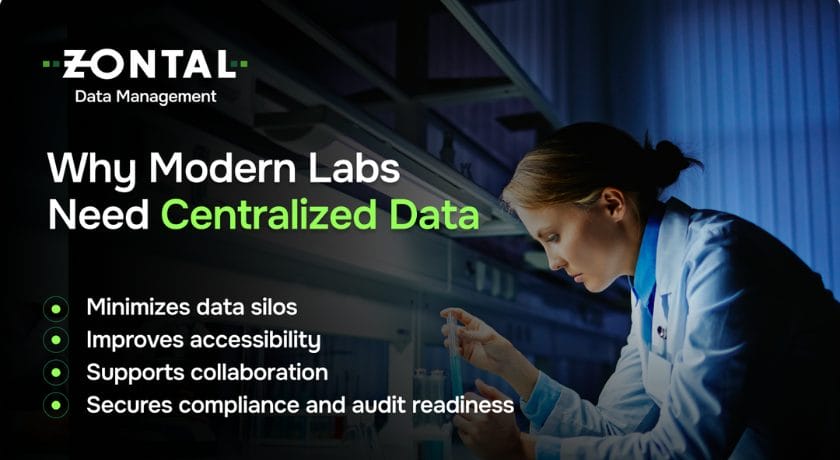
1. Minimizes Data Silos and Improves Accessibility
Labs run on multiple systems, such as ELNs and LIMS, each capturing a piece of the workflow. Without a central hub, this creates data silos that limit visibility and slow down decision-making.
An industry study found that nearly half of senior life sciences leaders identify data silos as the top barrier to scaling digital and analytics capabilities, highlighting the need for centralized data.
A unified data platform connects these sources, so teams can access and use information without chasing it across tools or departments.
2. Supports Collaboration Between Research Teams
Effective collaboration in life sciences requires standardized and accessible data.
Centralized systems bring together data from discovery research, process development, and manufacturing QC, ensuring insights can be shared and reused accurately.
This reduces redundant experimentation and accelerates project timelines by ensuring all stakeholders are working from a consistent, validated data set.
3. Secures Compliance and Audit Readiness
Regulated labs require accurate, traceable, and audit-ready data. Centralized systems deliver this with built-in version control, secure archiving, and audit trails.
They simplify compliance with GLP, GMP, and 21 CFR Part 11, keeping records inspection-ready and aligned with QA protocols.
3 Core Features of Scientific Data Management Systems
Scientific data management systems are enterprise-level platforms that help research and manufacturing labs:
- Collect
- Organize
- Store
- Preserve scientific data in a secure and standardized format
Ultimately, they serve as the central infrastructure for digital data workflows, especially in life sciences and biotech environments.
Let’s break down what it actually does:
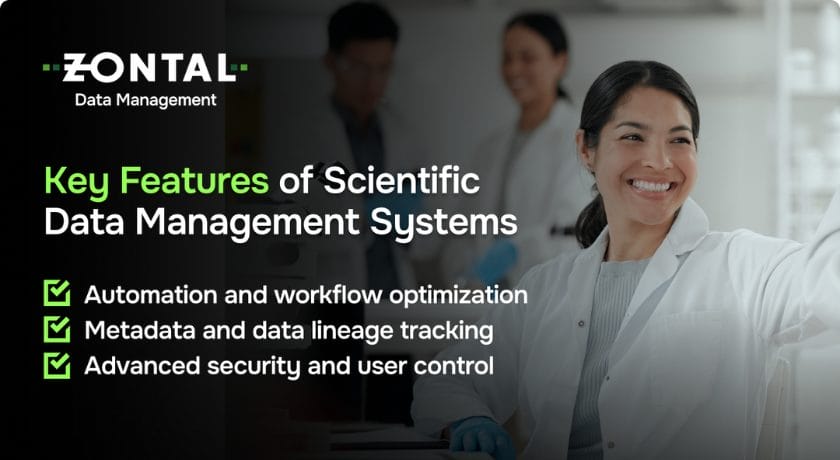
1. Automation and Workflow Optimization
An SDMS streamlines data capture, validation, and routing from instruments, LIMS, and ELNs to reduce manual work and prevent errors.
It handles routine tasks like file naming, approvals, and archiving, so teams can focus on analysis.
The payoff? Smoother handoffs, fewer delays, and data that drives momentum from lab bench to production line.
2. Metadata and Data Lineage Tracking
Each dataset is enriched with detailed metadata, capturing:
- The creator
- Timestamp
- Method used
- Experimental conditions behind the data
This ensures full traceability and lineage, enabling users to track every data point back to its origin.
Metadata also enhances searchability and reuse, supporting long-term data value and eliminating the need for repeated experiments.
3. Advanced Security and User Control
Scientific data management systems enforce strong security protocols through role-based access, encryption, and audit trails.
These features ensure only authorized users can access or modify data, supporting regulatory compliance and protecting intellectual property across global R&D, QC, and manufacturing environments.
Understanding the Role of FAIR Principles in Scientific Data Management
FAIR data principles are central to effective scientific data management across R&D, quality, and manufacturing.
They help teams unlock more value by making data easier to find, understand, and reuse, no matter its origin or who needs it next.
1. Streamlines Data Transparency and Reusability
FAIR data is structured to be easily understood and reused across teams.
This includes:
- Detailed metadata that captures context
- Standardized formats for consistency
- Persistent identifiers that ensure traceability
With this structure, records (from formulations to QC results) are easier to interpret, minimizing rework and enabling confident reuse across workflows.
2. Promotes Interoperability Across Systems
In labs running ELNs, LIMS, and MES, FAIR principles bridge gaps by enforcing common formats and semantic tags.
This enables smooth data flow across departments, so insights from R&D can directly inform manufacturing without translation delays.
3. Enables Long-Term Research Value Through Data Consistency
FAIR ensures data remains useful over time by enforcing structure, context, and sustainable formats. This also:
- Protects institutional knowledge
- Lays the foundation for AI readiness by ensuring data is machine-readable and semantically structured
- Generates consistent innovation across research, quality, and production
The importance of this long-term utility is more than theoretical.
A recent study showed how FAIR-aligned infrastructure supports the reuse and integration of complex biological datasets over time, underscoring the lasting impact of consistent data practices.
How To Evaluate Scientific Data Management Systems
Choosing the right scientific data management system can feel overwhelming; but it doesn’t have to be. Here’s a practical way to assess your options and find a solution that fits your lab’s needs.
- Does it connect with your existing tools? Your scientific data management system should work seamlessly with the systems you already use, think like ELNs, LIMS, instruments, and analytics platforms. If it can’t pull data from those sources, you risk more silos, not fewer.
- Is the data FAIR? Look for features that support FAIR principles: findable, accessible, interoperable, and reusable. That means solid metadata, consistent formats, and clear structure that makes your data easy to locate and reuse by both people and machines.
- How much does it automate? Efficient systems manage routine tasks like data capture, tagging, and archiving automatically. That reduces manual effort, cuts down on errors, and frees your team to focus on higher-value work.
- Is it secure and compliant? Make sure it includes features like role-based access, audit trails, and encryption. It should also help you meet standards like GLP, GMP, and 21 CFR Part 11 without extra overhead.
- Can it preserve your data long-term? You’ll want a system that keeps your data safe, intact, and usable years down the line. That means secure archiving in standardized, tamper-proof formats, especially for regulatory audits or historical analysis.
- Will it scale with your lab? As your operations grow, your system should keep up. That includes handling more data, supporting new workflows, and offering reliable vendor support when you need it.
Got scientific data headaches?
Consider ZONTAL As Your Next Scientific Data Management
ZONTAL cuts through the complexity of life science data with a single source of truth that’s built for speed, structure, and scale.
What does that look like in action? Here’s how ZONTAL delivers:
1. Centralizes Disconnected Systems
ZONTAL integrates ELNs, LIMS, instruments, and analytics tools into one streamlined platform. This eliminates data silos and gives teams quick, reliable access to the information they need.
Ultimately, this means no more chasing files across departments or systems.
2. Preserves and Protects Data
With secure, regulation-ready archiving, ZONTAL safeguards valuable scientific data for long-term use.
From method development and validation data to instrument outputs and batch records, all critical files stay traceable, tamper-proof, and audit ready.
3. Generates Smarter Workflows
ZONTAL automates key data processes, freeing teams from manual work and reducing errors. The result: faster decisions, higher consistency, and more efficient lab-to-production transitions.
4. Enables FAIR and AI-Ready Data
Built on FAIR data principles, ZONTAL enriches data with standardized metadata and formats.
This ensures that data is reusable, interoperable, and ready to power analytics, modeling, and machine learning initiatives.
5. Reinforces Continuous Innovation
From optimizing QC processes to scaling R&D experiments, ZONTAL keeps data organized, accessible, and aligned, allowing your team to focus on innovation rather than infrastructure.
If you’re ready to simplify your scientific data management and unlock its full potential, reach out to our team to see how ZONTAL can support you.
Make your scientific data searchable, structured, and future-proof.
Scientific Data Management: FAQs
What is scientific data management?
Scientific data management refers to the structured process of collecting, organizing, storing, accessing, and preserving scientific data throughout its lifecycle to ensure it remains accurate, accessible, and reusable.
This discipline is foundational in laboratories and research institutions where high data volumes, regulatory compliance, and long-term value are central.
What is a scientific data management system?
A scientific data management system is a software platform that manages, stores, and ensures scientific data is accessible, traceable, and reusable throughout its lifecycle.
It acts as the digital backbone for handling data in research environments, particularly in regulated sectors such as pharmaceuticals, biotechnology, and life sciences.
What should labs look for in scientific data management software?
Look for software that:
- Centralizes data from ELNs, LIMS, and instruments to eliminate silos
- Follows FAIR principles so data is reusable, accessible, and AI-ready
- Automates data handling to reduce errors and speed up workflows
- Supports compliance with GLP, GMP, and 21 CFR Part 11 through audit trails and secure access
- Preserves data long-term in standardized, tamper-proof formats
- Scales with your lab as data volume and complexity grow
Want to dig deeper into scientific data management?


