


 >
> The Value of Life Sciences Data Explained: Benefits & FAQs

Life Sciences Explained: Key Takeaways
- Life sciences data is uniquely complex, spanning diverse formats, long lifecycles, interdisciplinary users, and strict compliance requirements
- By decentralizing data ownership, Data Mesh empowers teams to manage and share their own data while still maintaining centralized governance
- The ZONTAL Life Science Analytics Platform helps unify fragmented lab data, automate key workflows, and make insights accessible to scientists
A recent Deloitte survey shows strong optimism in life sciences, with 68% of respondents expecting revenue growth and 57% forecasting margin gains in 2025.
Continued advances in science and technology are also expected to drive breakthrough innovation.
Life sciences data is uniquely complex, meaning it is highly variable, multi-dimensional, and often siloed across disparate systems.
To unlock its full potential, organizations should adopt strategies that make this data accessible, interoperable, and ready for machine learning at scale.
By the end of this guide, you will:
- Understand why life sciences data is unique
- Identify key challenges specific to life sciences data environments
- Learn how platforms like ZONTAL enable scalable and compliant workflows
See how ZONTAL simplifies life sciences data.

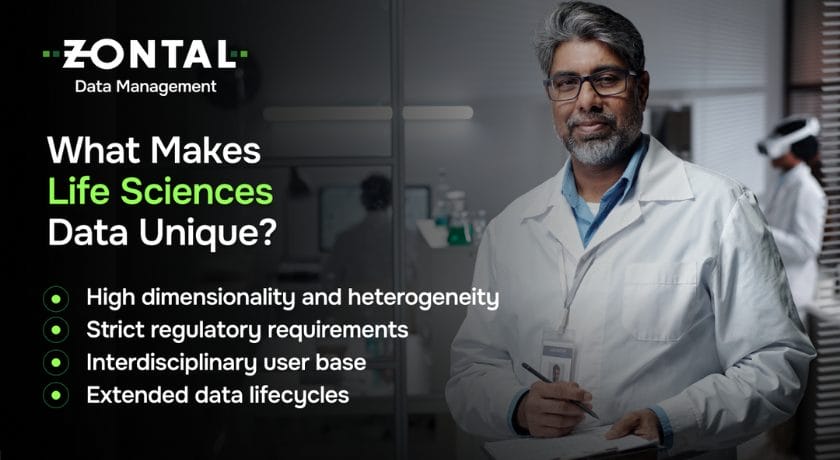
What Makes Life Sciences Data Unique?
Life sciences teams produce massive volumes of data, across experiments, instruments, and disciplines. But it’s not just the size that makes it challenging; it’s the diversity.
Here’s why managing data in life sciences is a whole different challenge:
1. High Dimensionality and Heterogeneity
From omics data and spectroscopy to assay results and instrument logs, life sciences data comes in wildly different formats, scales, and levels of structure.
Even within a single experiment, multiple data types may be produced that don’t naturally align.
2. Strict Regulatory Requirements
Life sciences data must comply with standards like 21 CFR Part 11 and ISO 17025, requiring traceability, version control, and audit trails.
This adds complexity to how data is captured, validated, and stored, especially across instruments, labs, and regulated workflows.
3. Interdisciplinary User Base
Life science professionals, pharma and biotech researchers, and scientific data managers all use the same data, but in different ways, with different tools.
Without consistent metadata and structure, sharing and reusing data across teams becomes a major challenge.
4. Extended Data Lifecycles
Data generated today might be reused years from now in a completely different context.
That means data archiving isn’t just about storage; it’s about making sure the data is still accessible, understandable, and usable long after it was first created.
Core Principles of Data Mesh in Life Sciences
Data Mesh is a decentralized framework for managing data at scale, founded on four core principles:
- Domain-oriented ownership
- Treating data as a product
- Enabling self-service infrastructure
- Implementing federated computational governance
For life sciences organizations navigating complex, high-volume data environments, these tenets naturally align with the FAIR data principles (Findable, Accessible, Interoperable, and Reusable).
- Domain-oriented design empowers scientific and operational teams to curate and label their own datasets, increasing the precision and visibility of data assets across the enterprise.
- Self-service data platforms ensure data accessibility without centralized bottlenecks, allowing cross-functional teams to leverage data more autonomously.
- Federated governance introduces scalable compliance protocols and standardized metadata practices, which are essential for maintaining interoperability in regulated environments.
- Treating data as a product ensures that each dataset is discoverable, usable, and maintained with lifecycle integrity. This maximizes its reusability across domains, projects, and analytical workflows.
Discover how ZONTAL turns lab data into research-ready insights.
Why Data Mesh Matters for Research Organizations
Research teams generate massive amounts of data across labs, instruments, and systems, but centralized data management often can’t keep up. It slows down access, creates bottlenecks, and makes collaboration harder.
Data Mesh offers a smarter alternative: by decentralizing data ownership, it keeps teams agile while ensuring data remains accessible, high-quality, and compliant.
1. Scalability That Grows With Research
As research efforts expand across disciplines, locations, or data sources, so does the challenge of managing data efficiently.
Data Mesh shifts data ownership to the teams generating and using it, allowing each group to manage their own datasets without relying on a centralized IT bottleneck.
This makes it easier to scale without constantly overhauling infrastructure.
2. Easier Access, Stronger Collaboration
In a Data Mesh, data is treated like a product, designed to be easily found, understood, and reused.
This means teams across science, operations, and analytics can access the data they need without roadblocks.
It breaks down data silos and supports better collaboration by creating a shared, consistent framework for data use.
3. Fewer Bottlenecks, Faster Insights
Centralized data systems often create delays due to overloaded pipelines and limited support.
Data Mesh solves this by enabling teams to work with their own data directly through self-service tools.
It speeds up analysis and decision-making, helping researchers move from question to insight without unnecessary friction.
4. Built-In Compliance and Data Quality
With federated governance built in, Data Mesh ensures that each team follows shared rules for access, quality, and security, right from the start.
This improves data integrity, reduces the need for rework, and supports readiness for audits, collaborations, or publishing requirements.
Challenges of Data Mesh in Life Sciences
While Data Mesh offers clear benefits for life sciences, implementing it in scientific environments introduces unique challenges that must be addressed, such as:
1. Cultural Shift
Many labs are used to handing off data, not owning it.
Adopting Data Mesh means teams need to take responsibility for maintaining and sharing their data, something that might require new habits, training, and clear incentives.
2. Data Literacy Gaps
Not every scientist or technician is fluent in concepts like metadata standards, data lineage, or schema validation. Expecting domain experts to manage data infrastructure is unrealistic.
What they need are simple, purpose-built tools, such as:
- Guided data entry forms
- Automated tagging
- Validation prompts
This enables reliable data management without pulling them away from their core research.
3. Legacy System Complexity
Most labs operate in a fragmented data landscape:
- Separate LIMS for sample tracking
- ELNs for experimental notes
- Instruments generating proprietary file formats
- File servers holding unstructured data
These systems rarely connect or speak a common language.
To support a functional Data Mesh, you need aligned data models, standardized formats, and semantic context that makes the data meaningful across teams.
Without this foundation, interoperability breaks down and the mesh loses its value.
4. Governance Overhead
Without the right tools, managing access, retention, and audit policies across multiple domains quickly becomes overwhelming.
The solution is automation because governance needs to be embedded directly into workflows, not added later as an afterthought.
How ZONTAL Powers Smarter Life Sciences Research
If you’re managing complex life sciences data, from instrument output to assay results and analytics pipelines, ZONTAL provides a purpose-built solution to streamline it end to end.
ZONTAL’s FAIR data platform helps organizations unify fragmented data, automate routine workflows, and unlock AI-ready insights, without overhauling your existing systems.
With features like centralized analytics hubs, built-in data transformation, and machine learning integration, ZONTAL helps life sciences teams move from data overload to data confidence.
In short: If you’re investing in better science through better data, ZONTAL can help you get there faster and more intelligently.
Make your life sciences data FAIR and future-proof.
Life Sciences: FAQs
What is a data mesh in scientific research?
Data Mesh is a modern approach to data architecture that decentralizes ownership.
In a scientific setting, this means treating data like a product: curated, well-documented, and ready to be shared or reused across the organization.
What challenges does a data mesh solve in life sciences?
In life sciences, organizations generate enormous volumes of data, from assays, bioreactors, and high-throughput screens to ELNs, LIMS, and instrument logs.
This centralized approach introduces several bottlenecks:
- Delayed access: Research or manufacturing teams often wait on the central team to clean, transform, or contextualize data before they can use it.
- Inconsistent context: Central teams may not fully understand domain-specific requirements, leading to errors or misinterpretations.
- Scalability issues: As the organization grows, the central team becomes overwhelmed, especially when dealing with diverse formats, ontologies, or regulatory needs.
How does data mesh support life sciences organizations?
Life sciences organizations generate massive amounts of data across labs, instruments, and systems.
Data Mesh helps by giving individual teams control over their own datasets, while still following shared standards.
This makes it easier to work across disciplines, speed up analysis, and reduce delays, without sacrificing data quality or compliance.
What role does data mesh play in scientific data governance?
Data Mesh uses federated governance, which means global rules, like access control, versioning, and retention, are applied locally within each team’s workflow.
This gives teams the flexibility to manage data their way, while still meeting regulatory requirements like ISO 17025. It’s a practical way to ensure data integrity without creating bottlenecks.
How does data mesh improve data management compared to traditional models?
Traditional data management relies on centralized systems like data lakes or warehouses, which can slow things down and create data silos.
Data Mesh changes by distributing responsibility and enabling self-service access to data through standardized tools and metadata.
It makes data easier to find, use, and trust, especially in complex life sciences environments.
Have more questions about life sciences data?


