


 >
> Integrating Scientific Data Isn’t a Project—It’s a Scalable Capability

Most pharmaceutical organizations have integrated some of their scientific data sources. Instruments connect to systems, workflows are partially digitized, and data is technically available across the organization.
But availability is not the same as usability.
Across R&D, teams still struggle to work with data in a consistent, scalable way. Information exists—but it is fragmented, delayed, or disconnected from the context needed to act on it. The result is a familiar gap: data is present, yet operational intelligence remains out of reach.
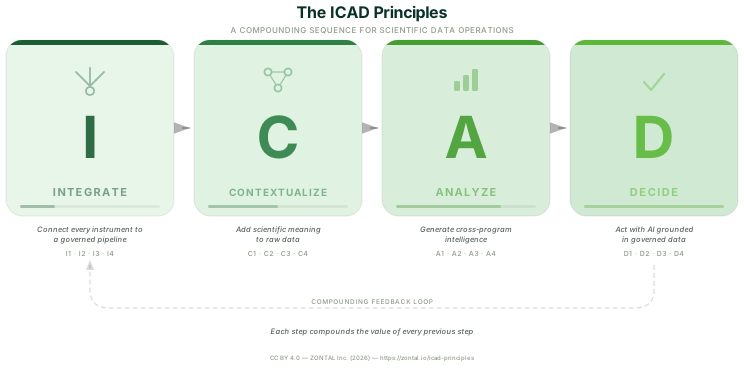
The ICAD framework—Integrate, Contextualize, Analyze, Decide—starts by addressing this gap at its source. Integrate is not treated as a technical step, but as the foundation for how data moves, evolves, and ultimately creates value.
Why Integration Still Falls Short
In many environments, integration has grown organically.
Systems have been connected over time, often in response to immediate needs—an instrument added here, a workflow digitized there. But these efforts rarely form a cohesive whole.
Data is still exported manually. Files move between systems without preserving full context. Even when integrations exist, they are often slow to implement and difficult to scale.
Even with FAIR data principles in place, many organizations still struggle to operationalize data. FAIR defines what good data looks like—but not how it flows through workflows or supports decisions at scale.
What “Integrate” Actually Means
Within ICAD, integration takes on a more precise meaning.
It is the act of connecting every scientific data source into a governed pipeline—one that captures data as it is created, preserves it in its original form, and maintains a complete record of its origin and transformation.
This is not just a technical improvement—it is a shift in how data is treated across the organization. Read the full definition: ICAD Principles.
Over time, this transforms integration into something more powerful. Each new data source strengthens the system, increasing the value of everything downstream.
From Projects to Pipelines
Traditionally, integration is approached as a series of projects. A new instrument arrives, a team works to connect it, and after weeks or months, the job is complete. Then the process begins again.
The ICAD model introduces a different way of thinking.
Integration becomes a continuous capability—a pipeline that improves with each implementation.
This approach is often described as an integration factory, where reusable components and standardized processes allow new data sources to be onboarded quickly and consistently.
Instead of starting from scratch each time, integrations are built faster, validated consistently, and scaled across the organization.
Start scaling integration from where you are today: ZONTAL Integrations.
Watch the Video
See how the ICAD Integrate principle is applied in practice, including how new instruments can be onboarded and data pipelines deployed in hours instead of weeks.
Integration in Practice
A practical example of this approach can be seen in ZONTAL’s integration model.
Rather than relying on specialized teams for every new integration, the process becomes structured and repeatable. Converters, validation workflows, and pipelines are reused and refined over time.
This enables organizations to connect new instruments quickly while maintaining governance, traceability, and compliance—turning integration into a scalable capability rather than a recurring challenge.
Why It Matters for AI and Analytics
Much of the conversation around digital transformation in pharma focuses on analytics and AI. But these capabilities depend entirely on the quality and consistency of the underlying data.
Without proper integration, data remains fragmented and incomplete. Models may run, but the insights they produce are limited by the data they receive.
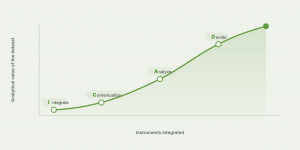
The ICAD framework makes this dependency explicit. Each step builds on the one before it—transforming raw data into decision-ready intelligence.
A Practical Starting Point
For many organizations, the challenge is not understanding the need for integration—it is knowing where to begin.
A practical approach is to start with a defined workflow or instrument set. Understand how data is generated, where it moves, and where it breaks down.
From there, introduce integration in a way that preserves context and improves flow.
Over time, these improvements connect, forming a more cohesive and scalable data environment—without requiring a full transformation upfront.
Closing Thought
Integration is easy to overlook because it often sits behind the scenes.
But in practice, it defines what is possible.
Organizations that treat integration as a scalable, governed capability move faster, operate more consistently, and unlock more value from their data. Those that treat it as a series of disconnected projects continue to face the same limitations.
Explore the ICAD Principles and start unlocking scientific data value.


