


 >
> From FAIR Data to Scalable Decisions

In 2016, the FAIR principles gave science a shared language for good data—findable, accessible, interoperable, reusable.
A decade later, pharmaceutical R&D organizations have adopted these practices. Data is more structured, more accessible, and better governed than before.
And yet, a fundamental challenge remains.
Organizations still struggle to answer portfolio-level questions—such as understanding stability trends across programs.
The issue is no longer whether data is “good.” It is whether that data can be used to drive decisions at scale.
The Gap Between Data and Decisions
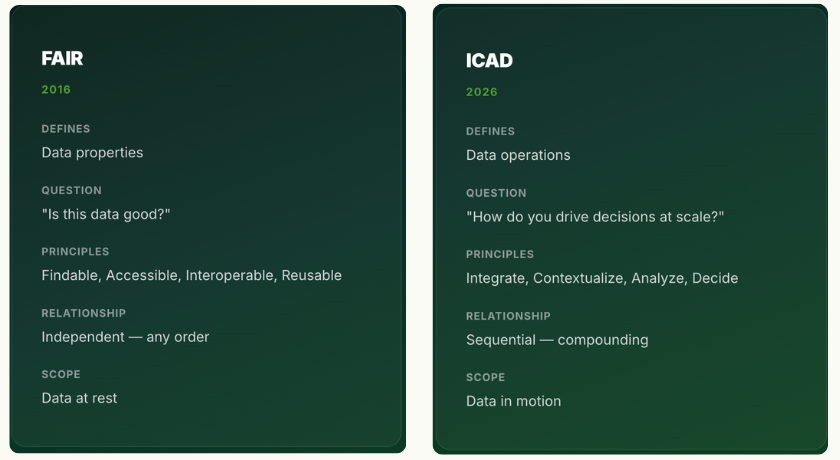
FAIR describes what scientific data should be. ICAD defines how that data drives decisions at scale.
This is the gap many organizations face today.
Data may be findable and accessible, but it is not yet connected, contextualized, or prepared to support consistent analysis across programs and sites. As a result, high-value questions remain difficult to answer—even when the data exists.
The ICAD framework—Integrate, Contextualize, Analyze, Decide—is designed to close this gap. It introduces a sequence of operations that transforms raw scientific output into decision-ready intelligence.
The ICAD Sequence
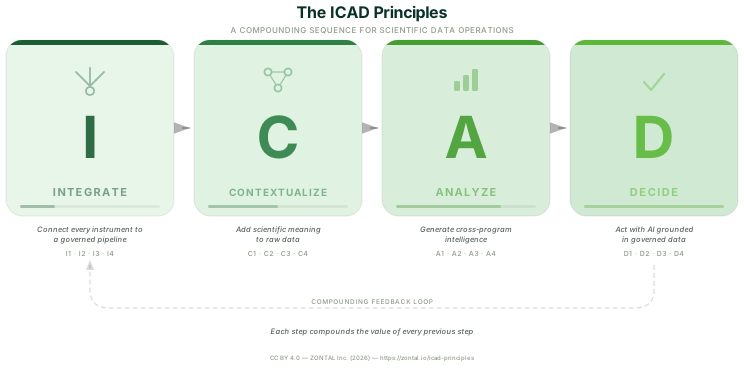
ICAD is built on four principles that operate as a single, compounding sequence. Each step increases the value of the next.
It begins with Integrate. Every scientific data source is connected to a governed pipeline. Data is captured at the point of creation, preserved in its native format, and maintained with full provenance. Over time, this process is industrialized, so each new data source can be integrated faster and more efficiently than the last.
Next, organizations Contextualize data. Each result is linked to its scientific meaning—method, sample, study, and program. Master data is reconciled across sites and systems, and context is structured in a way that is readable by both scientists and machines, rather than being trapped in reports or disconnected formats.
With this foundation in place, organizations can Analyze. Data can be compared across programs and sites using consistent methods. Models are traceable to their inputs, and insights can be reproduced by any analyst in any location.
Finally, organizations Decide. AI and analytics operate on governed data, with every recommendation remaining traceable to its source. Decision-making can be scaled, with autonomy applied where appropriate and results feeding back to improve the system over time.
Watch the Video
A short introduction to the ICAD framework and how Integrate, Contextualize, Analyze, and Decide work together to transform scientific data into decision-ready intelligence.
Why the Sequence Matters
What defines ICAD is not just the principles themselves, but the order in which they are applied.
Each step depends on the one before it. Data cannot be Contextualize if it has not been Integrate. You cannot Analyze without context. You cannot Decide without governed analysis.
This creates a compounding effect.
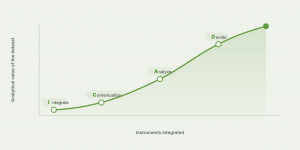
As more data sources are Integrate, the value of the entire dataset increases. Each new connection strengthens context, improves the ability to Analyze, and supports better decisions.
This is what enables organizations to move from isolated data to scalable, operational intelligence.
Closing Thought
FAIR asks an important question: Is this data good?
ICAD asks a different one: How do you use that data to Decide at scale?
Together, they define the full lifecycle—from data properties to data operations.
Discover how ICAD turns scientific data into decision-ready intelligence.


