


 >
> Data Lifecycle Management: 8 Stages, Benefits & FAQs
Data Lifecycle Management: Key Takeaways
- Data lifecycle management is foundational to scientific integrity and operational success
- The eight-stage lifecycle model ensures data is reliable, reusable, and compliant
- Through integration with ELNs, LIMS, and instruments, ZONTAL centralizes fragmented data into a usable, compliant platform
As digital systems transform every layer of life sciences, data lifecycle management has become essential to scientific operations.
Nearly every team member interacts with data in ways that impact compliance, innovation, and efficiency.
Without a structured approach to managing data across its lifecycle, organizations risk inconsistencies, inefficiencies, and regulatory setbacks.
Data lifecycle management provides the framework to manage that complexity. It ensures data remains consistent, traceable, and valuable over time, keeping it accessible, actionable, and compliant from initial capture to secure disposal.
In this article, we will:
- Explain why understanding the full data lifecycle is essential
- Cover the eight stages of data lifecycle management
- Show the benefits of effective lifecycle management
- Demonstrate how ZONTAL enables end-to-end lifecycle control
Bring structure to your scientific data with ZONTAL

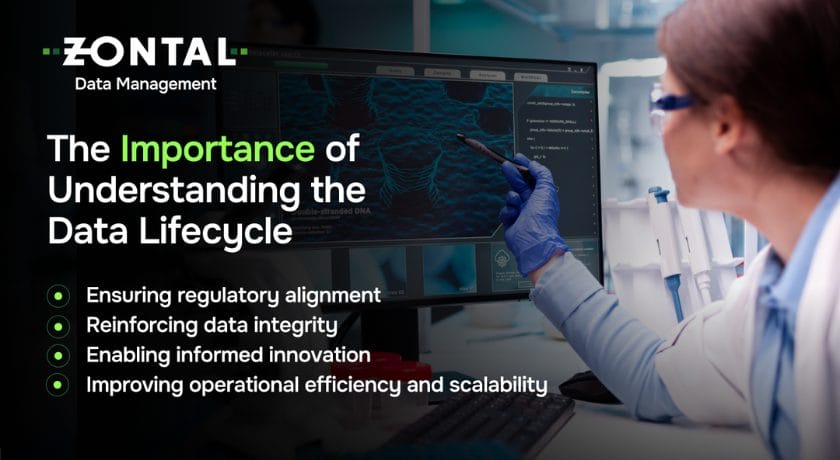
The Importance of Understanding the Data Lifecycle
Understanding the data lifecycle is essential to keeping data compliant and accurate at every stage, from the moment it’s created to when it’s archived or reused.
1. Ensuring Regulatory Alignment
In biotech and life sciences, compliance with frameworks such as FDA 21 CFR Part 11 and ISO 17025 requires complete traceability of scientific data.
Lifecycle awareness ensures your data is controlled, searchable, and audit-ready, reducing the risk of compliance gaps.
2. Reinforcing Data Integrity
Research organizations rely on highly granular, reproducible data. Understanding the data lifecycle can help:
- Protect intellectual property
- Preserve data fidelity across systems
- Maintain secure access throughout its usable lifespan
3. Improving Operational Efficiency and Scalability
Lifecycle-based strategies reduce manual data handoffs, eliminate redundancy, and ensure interoperability between lab systems.
This streamlines research workflows and scales efficiently as new instrumentation, and data sources are added.
4. Enabling Informed Innovation
Well-governed data supports high-quality analytics, enabling faster hypothesis testing, stronger reproducibility, and clearer insights, all of which accelerate discovery and product development.
The 8 Stages of Data Lifecycle Management
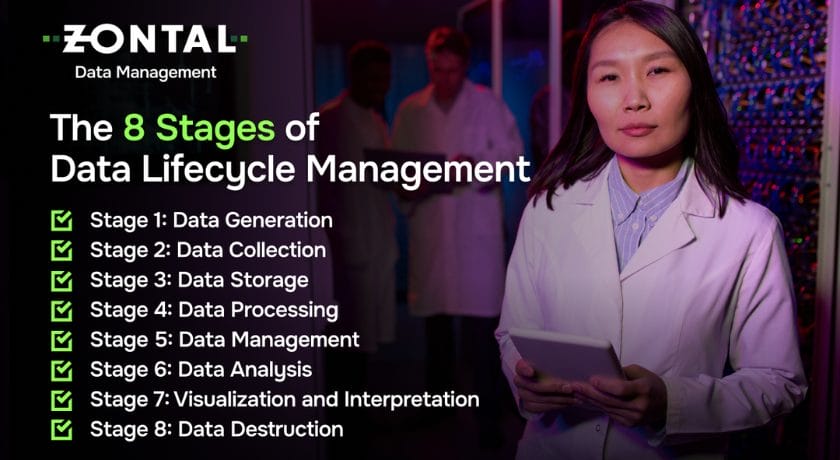
The eight stages of data lifecycle management define how scientific data is created, used, and governed from initial capture to compliant disposal.
Stage 1: Data Generation
Data creation begins at the source; this could be the lab bench, the production floor, or the analytics engine.
In biotech and life sciences, data is continuously generated across research, regulatory compliance, and production environments. This includes:
- Specifications and test results for raw materials and reagents
- Experimental protocols and batch production records
- Instrument readings from in-process controls
- Quality assurance and batch release reports
- Scientific observations and assay results
- Business operations data, including finance and supply chain analytics
Each data point carries scientific and operational weight, making consistent, traceable data generation essential for reliable downstream use.
Stage 2: Data Collection
Collection ensures raw data is systematically captured from its source.
Whether via automated lab instruments, digital forms, or ERP systems, structured data collection prevents early-stage data loss or errors.
In modern labs, instrument integration, LIMS, and IoT sensors streamline this process by minimizing manual entry and enabling timestamped, contextualized capture of scientific information.
Stage 3: Data Storage
Data must be housed in secure, scalable environments to support both short-term access and long-term retention.
Storage infrastructure might include cloud-based object storage solutions or hybrid approaches using on-premise servers for latency-sensitive applications.
For regulated environments, archival-grade media like LTO tape is still used for GxP-compliant retention policies. Choosing the right strategy requires balancing performance, cost, and regulatory requirements.
Stage 4: Data Processing
After collection, raw data must be transformed into standardized, usable formats. In biotech R&D, this often includes:
- Normalization of assay results across platforms
- Metadata tagging for contextual understanding
- Data encryption to protect intellectual property and comply with data integrity guidelines
- Semantic structuring to prepare datasets for downstream analytics, such as machine learning or cross-study comparisons
Efficient processing enables meaningful data reuse and lays the foundation for FAIR data principles.
Transform scattered lab data into a strategic asset.
Stage 5: Data Management
Once stored and processed, data requires governance.
This includes efficient backup strategies, version control, and access management aligned with user roles. Scientists and data preservation stewards must coordinate to define:
- Frequency and automation of backups
- Retention policies based on experiment type or regulatory status
- Access control mechanisms that protect sensitive data while enabling collaboration
Stage 6: Data Analysis
This stage is where raw and structured data transform into scientific insight. Analysis isn’t just about crunching numbers; it’s about translating data into experimental understanding and operational foresight.
Researchers and data scientists apply a variety of techniques, including:
- Multivariate statistical analysis to detect correlations between variables in complex biological systems
- Machine learning models to predict compound efficacy or identify genetic markers
- AI-based anomaly detection in manufacturing or assay data
- Mathematical modeling of biochemical pathways or dose-response curves
Each analytical method is selected to answer the relevant scientific question, with validated models ensuring accurate results before they guide research or development decisions.
Stage 7: Visualization and Interpretation
To make analysis actionable, complex data must be translated into intuitive visual narratives.
Interactive dashboards and visualizations help scientists and decision-makers grasp patterns, anomalies, or trends that may not be obvious in tabular data. For example:
- A process engineer might visualize batch-level deviations in fermentation runs to optimize yields
- A data scientist might overlay multiple omics datasets to identify biomarkers across experiments
- R&D teams might use heatmaps or network graphs to interpret relationships in high-throughput screening data
These visuals not only inform immediate decisions but also contribute to knowledge retention across teams and projects.
Stage 8: Data Destruction
Eventually, not all data retains long-term value. Regulatory compliance and good data stewardship require secure and auditable disposal of data that has exceeded its retention lifecycle.
In life sciences, this involves:
- Verifying that each dataset meets or exceeds its minimum regulatory retention requirement (think per GxP or ISO guidelines)
- Ensuring all physical and digital copies, including backups, are purged using validated destruction protocols
- Documenting destruction activities to preserve compliance audit trails
Effective data disposal protects intellectual property, minimizes storage costs, and ensures that outdated or redundant information doesn’t compromise active research or operations.
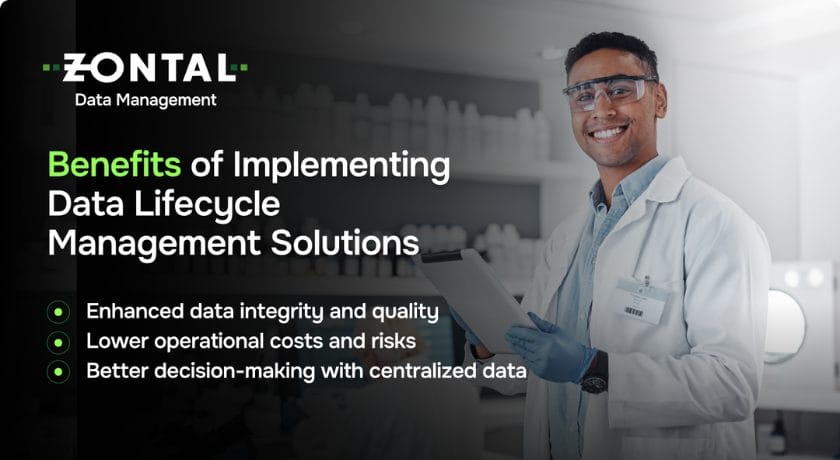
Benefits of Implementing Data Lifecycle Management Solutions
Getting data right from start to finish transforms scattered records into reliable, reusable assets.
Data lifecycle management improves traceability, minimizes errors, and gives R&D teams the clarity they need to make faster, evidence-based decisions.
1. Enhanced Data Integrity and Quality
Lifecycle management ensures scientific data is structured, traceable, and version-controlled across research and production. These practices enhance data quality and usability while supporting compliance.
As a result, reproducibility and reliability improve, which are critical for audits and collaboration.
A 2024 study confirms that aligning data stewardship with FAIR principles is essential for reusability and long-term scientific value in life sciences.
2. Lower Operational Costs and Risks
Centralizing and automating data handling eliminates redundancies and minimizes manual errors.
Standardized retention policies and secure disposal practices lower compliance risks and reduce storage overhead, especially in data-intensive research and manufacturing settings.
3. Better Decision-Making With Centralized Data
With integrated access to R&D, quality, and process data, teams can make faster, more informed decisions.
Centralized data environments support cross-functional analysis, enable advanced modeling, and accelerate innovation across the product lifecycle.
According to McKinsey, organizations adopting product-oriented data lifecycle strategies see measurable gains in decision-making agility and digital transformation outcomes across the life sciences sector.
Looking for a Lifecycle Management Solution? Here’s How ZONTAL Delivers
ZONTAL offers a purpose-built platform for life sciences and biotech organizations to manage the entire data lifecycle with precision.
From automated data capture and harmonized storage to semantic enrichment and long-term archiving, every phase is streamlined and compliant by design.
By centralizing data from ELNs, LIMS, and lab instruments into a unified, FAIR-aligned environment, ZONTAL eliminates silos and ensures data is always accessible, interpretable, and ready for reuse.
The result? Cleaner data, faster decisions, and greater confidence in everything from regulatory submissions to AI-driven analytics.
Manage your data lifecycle with ZONTAL.
Data Lifecycle Management: FAQs
What is data lifecycle management?
Data lifecycle management is the structured process of overseeing data from the moment it’s created to when it’s archived or deleted.
In life sciences, this includes managing everything from research findings to manufacturing batch records, also referred to as product data lifecycle management.
How does data lifecycle management help with regulatory compliance?
It keeps your data clean, consistent, and audit ready.
Tracking how data is captured, modified, and stored, ensures you meet standards like GxP and ISO, without the last-minute scramble before an inspection.
What are the typical data lifecycle challenges?
- Data silos
- Data security risks
- Inaccurate or outdated area
- Regulatory compliance struggles
How is ZONTAL different from typical LIMS or storage systems?
ZONTAL doesn’t just store data; it also makes it work for you.
It connects data from across your lab systems, standardizes it, and keeps it FAIR, so your team can actually find, reuse, and analyze it long after it’s been generated.
ZONTAL supports every stage of the data lifecycle.


