>
> ICAD: The Operational Complement to FAIR

FAIR data principles have become the global standard for scientific data stewardship, establishing a shared vision for how high-quality scientific data should be managed across modern research organizations. Over the last decade, FAIR has played a foundational role in shaping laboratory informatics strategies, data governance initiatives, and interoperability efforts across the life sciences industry.
However, despite broad alignment around FAIR principles, many pharmaceutical organizations still struggle to generate enterprise-scale scientific insight using FAIR compliance alone.
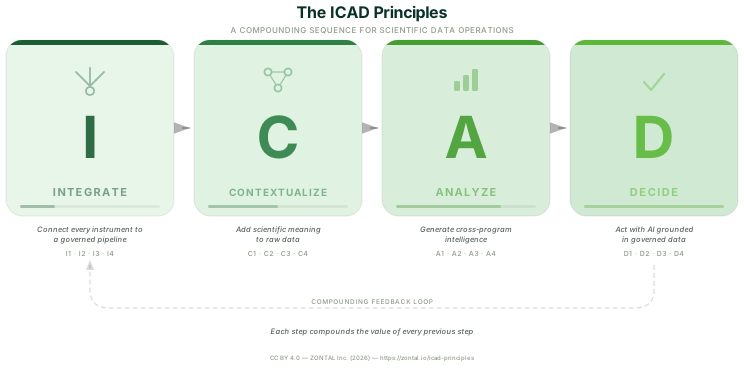
At the 2026 Spring Allotrope Connect Workshop, Wolfgang Colsman, CEO & Founder of ZONTAL, introduced ICAD — Integrate, Contextualize, Analyze, Decide — an open operational framework designed to address the growing gap between governed scientific data and actionable scientific intelligence.
The presentation explored how organizations must move beyond data stewardship principles alone and begin operationalizing scientific data in ways that support scalable analytics, AI-driven workflows, provenance-aware decision-making, and cross-domain scientific interoperability.
The Operational Gap Between FAIR Data and Scientific Decision-Making
FAIR principles define important characteristics of high-quality scientific data: data should be findable, accessible, interoperable, and reusable. However, FAIR does not prescribe how organizations operationalize data once it has been standardized and governed.
As many organizations continue scaling investments in AI, advanced analytics, and digital laboratory transformation, this distinction is becoming increasingly important.
Scientific data may technically satisfy FAIR criteria while still remaining operationally fragmented, difficult to contextualize, or disconnected from broader analytical workflows. As a result, many organizations continue to face challenges generating cross-program insights, tracing scientific lineage across systems, or enabling enterprise-scale AI initiatives.
ICAD was introduced as a complementary operational framework focused not only on how scientific data should look, but how scientific data must function across modern R&D environments.

Integrate
Connect every instrument to a governed pipeline
To support scalable scientific intelligence, organizations must establish governed pipelines capable of capturing scientific data at the point of generation while preserving native source data, provenance, and traceability.
This includes maintaining validated representations of both vendor-native data and standardized formats while supporting long-term preservation, lineage tracking, and future schema evolution.
The discussion emphasized that enterprise-scale scientific integration cannot rely on highly manual onboarding models. As laboratory ecosystems continue expanding, organizations increasingly require industrialized approaches capable of scaling integration across diverse instrument families, sites, and analytical domains.
This operational challenge becomes especially significant in regulated environments where data integrity, true-copy preservation, and validation requirements must remain tightly controlled.
Contextualize
Add scientific meaning to raw data
Standardized data alone is not sufficient for advanced scientific analytics or AI-driven workflows. Scientific information must also preserve semantic meaning, lineage, relationships, and contextual connections across experiments, materials, analytical methods, batches, systems, and projects.
The presentation explored how contextualized scientific data can form navigable “context graphs” capable of supporting machine-readable scientific understanding across connected laboratory ecosystems.
This context helps enable traceability, cross-domain interoperability, semantic querying, and AI-assisted scientific exploration.
As organizations adopt increasingly heterogeneous laboratory architectures, semantic interoperability and lineage-aware data structures are emerging as important capabilities for enabling trusted scientific intelligence at enterprise scale.
Analyze
Generate cross-program intelligence
Once scientific data has been integrated and contextualized, organizations can begin applying governed analytical workflows across connected datasets.
The presentation highlighted how contextualized scientific data enables organizations to apply statistical models, compare historical trends, aggregate data across programs, and generate insights using standardized and traceable scientific information.
Supported capabilities include:
- Cross-program scientific comparison
- Root cause investigations
- Batch and stability analysis
- Predictive modeling
- AI-assisted scientific exploration
- Enterprise-wide analytical workflows
Importantly, the discussion emphasized that analytics must remain connected to governed provenance and contextualized source data in order to support trustworthy scientific decision-making.
Decide
Act with AI grounded in governed data
As AI becomes increasingly integrated into pharmaceutical R&D environments, organizations must ensure that analytical outputs, recommendations, and decisions remain explainable, traceable, and grounded in governed scientific evidence.
The presentation explored how lineage-aware architectures can support transparent decision-making by connecting analytical results back to integrated source data, contextual relationships, analytical models, and provenance records.
This becomes particularly important in regulated scientific environments where explainability, validation, and traceability remain essential requirements for operational trust and compliance.
Rather than treating AI as an isolated analytical layer, ICAD positions AI-driven workflows as dependent upon governed integration, contextualization, and analytical infrastructure.
What Separates ICAD from a Checklist

The Future of Scientific Data Infrastructure
As pharmaceutical organizations face increasing pipeline pressure, expanding data complexity, and accelerating AI adoption, the ability to operationalize scientific data is becoming increasingly important.
The concepts introduced through ICAD reflect a broader industry transition away from isolated data governance initiatives toward connected, contextualized, and operational scientific data ecosystems capable of supporting enterprise-scale scientific intelligence.
Rather than viewing FAIR compliance as the endpoint, organizations are increasingly recognizing the need for operational frameworks that enable scientific data to move from integration to contextualization, analytics, and ultimately transparent decision-making.
Watch the Session
Watch the webinar to explore how ICAD complements FAIR principles and helps establish the operational foundation for AI-ready scientific data infrastructure.