


 >
> ELN Integration: Importance, Challenges & Strategies

ELN Integration Explained: Key Takeaways
- Integrating ELNs with systems like LIMS, instruments, and ERP platforms creates a centralized environment
- Integrated ELN systems automate high-volume tasks and include built-in compliance features like audit trails, secure access, and version control
- To maximize impact, labs must standardize metadata, prioritize high-value system connections, and align ELNs with enterprise data strategies
The era of paper lab notebooks and hard-to-read handwritten entries is quickly fading.
As labs shift toward fully digital environments, the way scientific data is captured and accessed is evolving just as quickly.
Electronic lab notebooks (ELNs) simplify how research is documented, organized, and shared.
When integrated with other lab systems, ELNs also make collaboration easier and faster, connecting teams and data in ways that traditional methods never could.
Unify your lab systems with smart ELN integration.

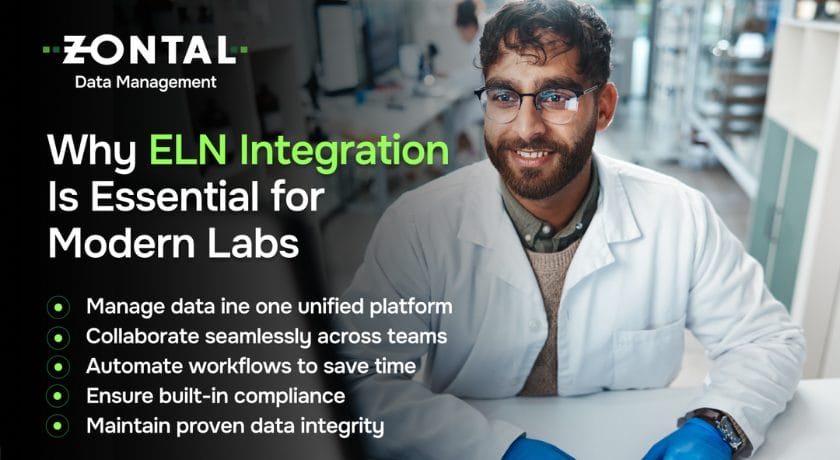
Why ELN Integration Is Essential for Modern Labs
ELN integration connects electronic lab notebook (ELN) software with other key lab systems, such as LIMS, instruments, and ERP platforms, to create a unified, automated data environment.
Instead of juggling disconnected tools or relying on manual entry, teams can centralize information, capture data in real time, and improve traceability.
Here’s how ELN integration can make a difference in your lab:
1. Unified Data Management That Drives Decisions
Modern labs rely on vast amounts of data generated across multiple systems, and when those systems operate in isolation, vital insights get delayed or lost.
Integrating ELNs with core platforms like LIMS, instruments, and analytics tools creates a centralized environment where experimental data is consistently captured, easily accessed, and fully traceable.
This isn’t just theoretical. A 2024 study confirms that connected systems reduce manual errors and enhance traceability from sample collection through analysis.
With fewer data silos and less manual cross-referencing, teams can move faster from experiment to insight.
2. Scalable Collaboration Across Teams
As research becomes more global and cross‑functional, real‑time collaboration is essential.
ELN integration allows teams across departments, sites, and external partners to work from a shared, up‑to‑date dataset.
This consistency minimizes duplication, improves handoffs between groups, and ensures continuity as projects move from research into QC or manufacturing.
3. Automated Workflows That Free Up Time
Manual data entry and disconnected tools slow research down and increase risk.
ELN integration automates routine tasks, such as instrument data capture, calculations, and report generation, so scientists can focus on analysis rather than administration.
When combined with SaaS platforms, ELNs can also support advanced workflows like AI‑driven analytics, regulatory reporting, and inventory management.
4. Built‑In Compliance and Proven Data Integrity
In regulated environments, integration is more than an efficiency gain; it’s a compliance requirement.
ELNs connected with quality and compliance systems support frameworks like FDA 21 CFR Part 11 and GMP through audit trails, version control, and secure access.
LIMS and ELN Integration: How They Work Together
Data needs to do more than just exist, as it has to move efficiently, connect across systems, and support fast decisions.
Integrating your electronic lab notebook (ELN) with your laboratory information management system (LIMS) can help make that happen.
LIMS manages the operational side of the lab: tracking samples, managing test workflows, scheduling instruments, and storing compliance data.
Meanwhile, ELNs capture the scientific side of the work, where researchers document experiments, observations, calculations, and conclusions.
Basically, when you connect the two, you get the following benefits:
- Data moves automatically from one system to the other
- You get full traceability, linking sample IDs and test results with the context behind the work
- Scientists can access everything they need in one place, speeding up analysis and decision-making
- Compliance gets easier, with audit trails and documentation captured consistently
- Teams spend less time on admin and more time on actual research
In a nutshell, LIMS tracks the “what” and “when,” while ELNs capture the “how” and “why.”
Cut manual work with ELN and LIMS connectivity.
Challenges Without ELN Integration
When your electronic lab notebook (ELN) isn’t connected to other lab systems, it creates friction that slows teams down and adds risk to your workflows.
Without integration, labs often run into a few common issues:
1. Manual Data Entry and Extra Work
Scientists end up retyping the same information across systems, which takes time and increases the chance of errors.
2. Data Stuck in Silos
Key data gets scattered across platforms, making it harder to get a complete picture of samples, results, or experiments.
3. Slower, Less Efficient Workflows
Without automation between systems, moving data between teams, like R&D and QC, becomes a manual, time-consuming process.
4. Limited Traceability and Compliance Gaps
It’s harder to maintain audit trails, version control, and proper documentation, all of which are essential for meeting regulatory standards.
5. Disconnected Teamwork
Teams in different departments or locations can’t easily access the same data or experiment history, which slows down collaboration and creates misalignment.

Best Practices for Effective ELN Integration
Now that you understand the benefits of ELN integration, the next step is putting best practices into action. Here’s how they can help your lab work more efficiently and effectively:
1. Map Data Workflows Across the Lab
Begin by identifying where data is generated, how it’s captured, and who uses it.
For example, trace how a QC test moves from instrument output to batch record approval.
This allows you to pinpoint integration gaps, like manual transcription between instruments and the ELN, and define system touchpoints based on actual lab flow, not assumptions.
2. Prioritize High-Impact Integrations First
You don’t need full integration from the start. Focus first on the connections that remove the biggest bottlenecks.
For instance, linking your ELN to the LIMS can eliminate redundant data entry for sample metadata.
Connecting key instruments, like balances and spectrometers, automates raw data capture, improves accuracy, and can save your team hours each week.
3. Standardize Experimental Metadata
Inconsistent metadata makes it more difficult to search, analyze, and reuse data across experiments.
To avoid this, define controlled vocabularies for experiment types, reagent names, and instrument IDs, and apply them using structured ELN templates.
This lowers variability, improves traceability, and ensures your data is ready for cross-study analysis and future AI applications.
4. Select a Platform That Fits Your Ecosystem
Choose an ELN with proven integration support for the systems you already use.
The platform should offer open APIs, role-based access control, Part 11 compliance features, and the flexibility to support both research and QA workflows.
5. Build a Clean Migration Path
Legacy data holds value only if it’s both accessible and reliable. Start by identifying which records need to be migrated, which can be archived, and how each dataset will be validated.
Focus first on active studies and regulatory-critical files. To maintain consistency, establish SOPs for naming conventions, version control, and storage throughout the migration process.
6. Embed Compliance Into the Workflow
Compliance shouldn’t be an afterthought; it should be built into your workflows from the start.
Integrate electronic signatures, audit trails, version control, and time-stamped entries directly within your ELN processes.
Align these features with regulatory standards like 21 CFR Part 11, GLP, and GMP to ensure your documentation is always inspection ready.
7. Automate Where Precision Matters
Most labs use ELN integrations to automate high-risk or high-volume tasks, such as generating dilution calculations, validating results against specification limits, or transferring LIMS data into structured experiment records.
These automations don’t just save time; they also improve accuracy and reduce the chance of error where it matters most.
8. Equip Users With Contextual Training
Generic training won’t drive successful adoption. Instead, tailor onboarding to each user’s role.
A QC analyst will need a different workflow than a discovery scientist. Provide role-specific SOPs, quick-start guides, and walkthroughs based on real lab scenarios.
After launch, keep feedback channels open to refine workflows and address issues as they come up.
9. Monitor ELN Usage and Optimize Workflows
Define clear KPIs from the start, such as reduction in manual data entry, time to batch release, or audit cycle time.
Use these metrics to refine integrations, identify underused features, and justify further investment.
10. Align With Enterprise Data Strategy
Your ELN shouldn’t operate in isolation.
It should be part of a broader digital lab strategy, one that supports FAIR data principles, connects seamlessly with analytics platforms, and enables AI and machine learning initiatives.
Treat the ELN as a strategic data layer, not just a place to store documentation.
How ZONTAL Enables Seamless ELN Integration
ZONTAL simplifies ELN integration by acting as a unified data platform that bridges electronic lab notebooks (ELNs) with other core lab systems.
This seamless connectivity allows life sciences organizations to unify data and maintain compliance across complex digital environments.
Here’s what that looks like in action:
1. Centralized Data Connectivity
ZONTAL connects ELNs with broader enterprise systems, creating a single source of truth.
This eliminates data silos and supports efficient, compliant workflows across pharma, biotech, and research organizations.
2. Enhanced Data Visibility and Traceability
Through seamless integration, ZONTAL enables real-time access to scientific data, helping teams track the full context of experiments, from sample metadata to analytical outputs, without switching between systems.
3. Reinforce Compliance and IP Protection
ZONTAL preserves data integrity with audit trails, version control, and long-term archiving aligned with standards like 21 CFR Part 11. This helps organizations meet regulatory requirements while protecting intellectual property.
4. Automation of ELN Data Workflows
By automating the flow of data from ELNs to other platforms, ZONTAL eliminates repetitive data entry, minimizes errors, and accelerates scientific and operational decision-making.
5. Scalable, Future-Ready Architecture
ZONTAL is designed to support FAIR data principles and AI/ML readiness. It ensures that scientific data collected today can be reused, analyzed, and scaled across departments and over time.
Tired of fragmented data?
ELN Integration: FAQs
What is ELN integration?
ELN integration is the process of connecting your electronic lab notebook with other lab systems, like LIMS, ERP platforms, instruments, and inventory tools, to create a unified digital environment.
What does an ELN do?
An ELN is the digital version of a lab notebook, designed to replace paper-based records. It helps scientists easily document experiment details, observations, and results.
By capturing unstructured scientific data, ELNs become a core part of modern lab software ecosystems.
LIMS vs. ELN: What’s the difference?
Think of LIMS as the system that keeps lab operations running smoothly. It manages structured data, tracks samples, and connects to instruments.
ELNs, on the other hand, focus on the science itself, capturing experiment details, protocols, and collaboration between researchers.
Have more questions about ELN integration?


