


 >
> Scientific Data: Characteristics, Applications & FAQs

Scientific Data Explained: Key Takeaways
- As the life sciences industry moves deeper into a data-driven transformation, the volume and complexity of scientific data continue to grow
- Modern scientific data management demands systems that go beyond storage, supporting accuracy, traceability, interoperability, and compliance
- To stay competitive and compliant, life sciences organizations must regularly assess how they manage scientific data
In 2026, the life sciences industry, especially pharmaceutical R&D, is deep into a data-driven transformation. Experts say that when the numbers are all in, the 2025 market will be estimated at USD 100.88 billion.
Driving this shift is the growing volume and complexity of scientific data, which continues to expand at an unprecedented pace.
AI, big data analytics, natural language processing, and cloud computing are actively redefining how teams discover new drugs, manage quality control, and optimize manufacturing processes.
If your organization’s scientific data feels fragmented, difficult to access, or unfit for modern analytics, it may be time to re-evaluate how you manage it.
In this guide, we will explore:
- What effective scientific data management looks like today
- The key challenges facing R&D, QC, and manufacturing teams
- What to look for in a future-ready scientific data management platform
ZONTAL makes scientific data manageable.

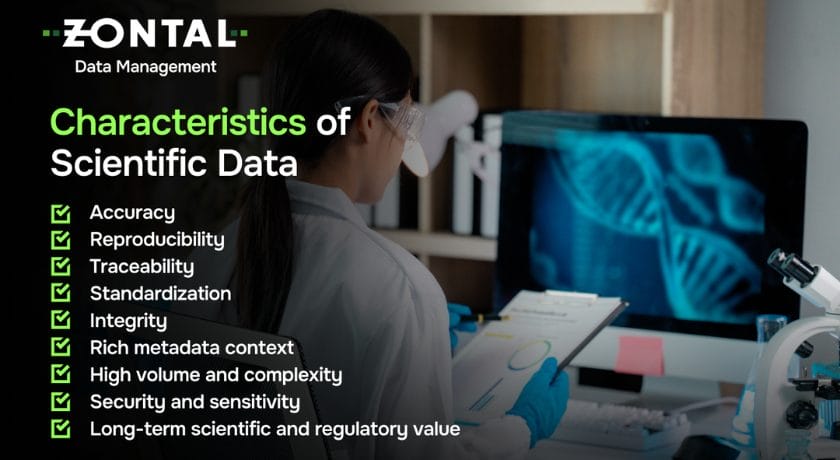
Key Characteristics of Scientific Data
Scientific data isn’t just a collection of numbers. In fact, it’s what drives decisions at every stage, from early research to regulatory approval.
But for that data to truly deliver value and hold up under scrutiny, it needs to meet some key criteria throughout its lifecycle:
1. Accuracy
Measured values such as compound concentrations, assay results, or gene expression levels must accurately represent the true conditions of the experiment or sample.
Even small inaccuracies can cascade into failed trials, flawed conclusions, or unsafe products reaching the market.
2. Reproducibility
To be reliable, scientific data must produce consistent results when the same protocols are repeated.
This level of reproducibility is essential for validating preclinical findings and meeting the rigorous standards required for regulatory submissions.
3. Traceability
Every data point must be fully traceable. This means it should be clearly linked to who generated it, when it was created, which instrument was used, and the conditions under which it was produced.
This level of traceability is essential for audit readiness and internal investigations.
4. Standardization
Data should follow controlled vocabularies, formats, and units (think µg/mL vs. mg/L), enabling harmonization across instruments, labs, and systems.
5. Integrity
To ensure integrity, scientific data must remain complete, unaltered, and safeguarded against tampering throughout its lifecycle.
Regulatory frameworks such as 21 CFR Part 11 and ALCOA+ demand strict controls, including audit trails, user authentication, and system validation, to guarantee data is trustworthy and legally defensible.
6. Rich Metadata Context
Metadata such as experiment purpose, reagent batch numbers, and instrument settings provides essential context for interpretation and reuse.
7. High Volume and Complexity
Biotech research produces vast volumes of highly diverse data, from high-throughput omics files like FASTQ and BAM to structured quality control reports.
Managing this mix of formats and scales requires robust infrastructure, standardized data models, and interoperable systems to ensure the data remains usable across analytical pipelines, teams, and time.
8. Security and Sensitivity
Scientific data often contains highly sensitive information, like personally identifiable data (PII), proprietary compound structures, and confidential clinical trial results.
Protecting this data requires more than basic security; it demands:
- Role-based access controls
- End-to-end encryption
- Secure audit trails
- Compliance with regulatory frameworks like GDPR and 21 CFR Part 11 to safeguard intellectual property
9. Long-Term Scientific and Regulatory Value
Scientific data holds long-term value, whether for future studies, regulatory re-submission, technology transfer, or training AI models.
To unlock this value, data must be preserved in sustainable formats and structured for findability, accessibility, interoperability, and reusability.
Following these FAIR principles ensures that data remains usable, verifiable, and actionable years or even decades after it was originally collected.
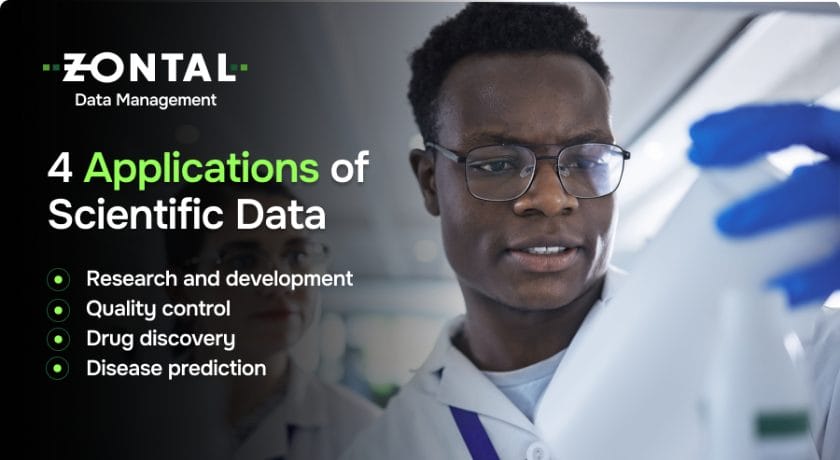
4 Applications of Scientific Data
From unraveling biological mysteries in the lab to keeping large-scale production on track, scientific data is quietly powering some of the biggest breakthroughs in both biotech and life sciences.
1. Research and Development
High-volume data from experiments, instruments, and connected lab systems allow researchers to design more precise studies, identify process inefficiencies, and validate findings faster, all while reducing manual effort and experimental variability.
Integrated data systems also help R&D teams iterate faster and scale discoveries more effectively.
2. Quality Control
Accurate, real-time data is essential for meeting regulatory and safety standards.
When companies automate data collection and monitoring, they’re better equipped to keep processes consistent, maintain traceability, and stay compliant.
And it’s not just talk. In fact, a 2024 study on pharma quality systems found that real-time data automation led to tighter process control, fewer errors, and more reliable product quality across the board.
3. Drug Discovery
AI and machine learning are reshaping drug development by turning vast, complex datasets into predictive models that accelerate discovery and reduce risk.
These technologies are used to:
- Identify high-potential drug targets by analyzing biological pathways, genetic markers, and disease mechanisms at scale
- Predict compound efficacy and safety early in the pipeline, using in silico modeling to reduce costly late-stage failures
- Optimize preclinical and clinical testing by optimizing trial design, patient selection, and biomarker analysis, ultimately cutting time to market and improving success rates
A 2025 review reinforces this shift, showing how AI is accelerating drug development by rapidly analyzing large-scale biomedical data to pinpoint targets, forecast compound performance, and streamline drug design.
4. Disease Prediction
When researchers combine genomic, clinical, and environmental data, they can uncover early indicators of disease, model how conditions progress over time, and anticipate broader public health risks.
This integrated approach supports earlier interventions, more personalized treatment strategies, and faster responses to emerging health threats.
Evaluating Scientific Data Management Across Six Core Dimensions
Whether your organization is developing a new drug or scaling up production, how you manage your scientific data can make or break your success.
To get a clear picture of where you stand, it’s worth taking a close look at these six key areas:
1. Accessibility and Discoverability
Scientific data must be easy to locate, retrieve, and interpret across teams and timeframes.
If researchers are wasting time navigating folders or reconciling file versions across siloed systems, your data is not working for you.
Centralized repositories, enriched with secure metadata and semantic tags, make it easy to find and reuse data across teams and workflows.
2. Data Quality and Integrity
Your systems should enforce consistent data validation, standard nomenclature, and full lifecycle traceability.
Every dataset should be complete, accurate, and tamper-proof, with audit trails capturing who did what and when.
3. Interoperability and Data Standards
Modern labs run on interconnected systems, such as LIMS, ELNs, instruments, and analytics platforms. If these systems can’t exchange data seamlessly, inefficiencies multiply and data quality degrades.
Look for use of open standards (AnIML, Allotrope) and real-time data exchange through APIs to ensure consistency and scalability.
4. Regulatory and Audit Readiness
Scientific data must withstand regulatory scrutiny at any point. That means secure access controls, validated systems, proper versioning, and audit-ready archives.
Your ability to quickly compile submission data or respond to an inspection is a direct reflection of your data management maturity.
5. Workflow Efficiency and Automation
Manual data entry, disconnected spreadsheets, and file conversions are indicators of an outdated workflow.
Automated processes like real-time instrument data capture, sample tracking, and auto-generated reports reduce errors and free up scientific time.
Efficiency here directly improves throughput and lowers compliance risk.
6. Long-Term Value and FAIR Compliance
Your data should serve more than today’s study. It should power future R&D, regulatory resubmissions, or AI model training.
Preserving it in durable, standards-based formats and organizing it according to FAIR principles ensure it remains actionable years down the line.
Drowning in fragmented scientific data?
Why ZONTAL Should Be Your Scientific Data Management Platform
Scientific data management goes beyond storage, as it also demands speed, structure, compliance, and long-term value.
ZONTAL meets that challenge by simplifying complex data landscapes through a unified data platform that scales with your science.
Here’s how it drives impact across the entire data lifecycle:
1. Connects Disparate Systems Into One Unified Platform
ZONTAL integrates ELNs, LIMS, instruments, and analytics tools, creating a single source of truth across your lab and enterprise.
By eliminating data silos, it gives teams immediate, reliable access to the information they need. This means no more searching across disconnected systems or departments.
2. Secures and Future-Proofs Your Data
From method development to batch records and instrument outputs, ZONTAL ensures that every file is preserved, traceable, and protected.
Its archiving architecture is built to meet regulatory expectations, so your data stays compliant, audit-ready, and accessible for years to come.
3. Automates Data Workflows to Boost Productivity
ZONTAL automates critical processes like data capture, validation, and reporting, reducing manual tasks, minimizing errors, and accelerating turnaround times.
This frees up scientists, who can spend less time on paperwork and more time on high-value research and decision-making.
4. Ensures Your Data Is FAIR and AI-Ready
With built-in FAIR data principles, ZONTAL enriches your datasets with standardized metadata and formats, making your data immediately usable while also preparing it for future AI, analytics, and modeling applications.
5. Supports Continuous Innovation at Scale
Whether you’re optimizing QC processes or expanding complex R&D initiatives, ZONTAL keeps your data organized, aligned, and accessible.
It provides the digital backbone needed to scale operations without compromising agility, compliance, or insight generation.
Curious what ZONTAL can do for your lab?
Scientific Data: FAQs
What is scientific data?
In life sciences, scientific data starts with vast datasets that are analyzed using AI and machine learning.
These tools convert raw scientific data into meaningful insights that drive:
- A deeper understanding of biological systems
- Faster, more efficient drug discovery
- Streamlined and optimized research workflows
What is a scientific data management system?
A scientific data management system is a software solution designed to organize, store, and maintain scientific data so it remains accessible, traceable, and reusable across its entire lifecycle.
It serves as the digital foundation for research operations, especially in highly regulated fields like pharmaceuticals, biotechnology, and life sciences.
What makes scientific data different from regular enterprise data?
Scientific data is high-volume, highly complex, and deeply tied to experimental context. It spans structured results, unstructured files (like images or logs), and rich metadata on methods, instruments, and conditions.
Unlike typical business data, it must be rigorously documented, validated, and preserved to meet regulatory, reproducibility, and AI-readiness requirements.
Need help making sense of your lab’s scientific data challenges?


