


 >
> Metadata Management in Life Sciences: Benefits & FAQs

Metadata Management Explained: Key Takeaways
- Metadata management is foundational to scientific integrity, compliance, and reusability
- Structured metadata brings FAIR principles to life
- ZONTAL helps you capture, standardize, and manage metadata from ELNs, LIMS, and lab instruments, all in one place
Think of metadata as the labeling system on everything in a high-tech lab freezer. Without those labels, sample names, dates, and storage conditions, just see racks of identical tubes.
Metadata tells you what the data is, where it came from, how it’s been handled, and how it should be used. Extend that labeling mindset beyond the lab bench, reaching across every experiment, file, and system your team interacts with.
That’s where metadata management comes in. It transforms scattered details into organized, searchable, and trustworthy information, giving your data the context it needs to be truly usable and consistently valuable.
In this article, we will:
- Highlight why metadata management matters in life science
- Explain how it works
- Share how structured metadata enables data to be FAIR
- Outline three measurable benefits of metadata management software
- Position ZONTAL’s role in metadata management
Take control of your metadata management with ZONTAL.

Why Does Metadata Management Matter in Life Sciences
In life sciences and biotech, metadata management is foundational to ensuring scientific data is trustworthy, traceable, and ready for reuse.
This is the point at which metadata management becomes indispensable in life sciences.
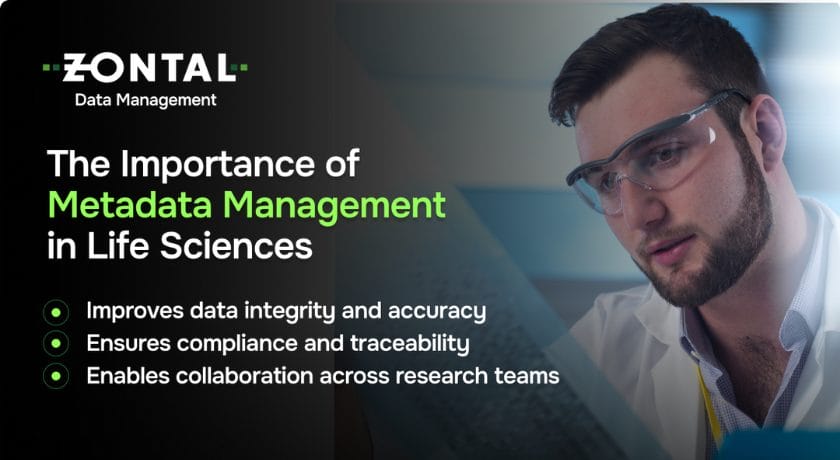
1. Improving Data Integrity and Accuracy
Metadata documents critical experimental parameters, such as instrument settings, reagent lots, and workflow steps, ensuring that results are accurate and reproducible.
It reduces the risk of misinterpretation, supports data validation, and maintains clear lineage from raw data to decision-making.
2. Enabling Collaboration Across Research Teams
Metadata records who performed an action, when it occurred, and how it was carried out, providing the foundation for GxP compliance, audit trails, and robust access control. It underpins traceability across regulated lab and production environments.
A recent study on FAIR Data Station reinforces this, showing that machine-actionable metadata is key to reusing complex datasets across functions.
How Does Metadata Management Work?
In life sciences, metadata management supports data integrity, compliance, and scientific reproducibility.
Let’s walk through it:
- Capture: Metadata is collected from ELNs, LIMS, and lab instruments, either automatically or manually, to include essential context like protocols, sample annotations, and experiment conditions.
- Centralize: That metadata is stored in a unified catalog, making it easier to search across systems, trace data lineage, and understand relationships between datasets.
- Standardize: Controlled vocabularies and domain ontologies (think CDISC and SNOMED) are applied to ensure consistency and interoperability across teams and platforms.
- Govern: Access controls, audit trails, and validation workflows are enforced to meet requirements like FDA 21 CFR Part 11 and internal quality standards.
- Activate: With well-managed metadata, organizations enable FAIR data practices, improve collaboration, and prepare datasets for AI-driven insights.
Bring clarity to your data with ZONTAL.
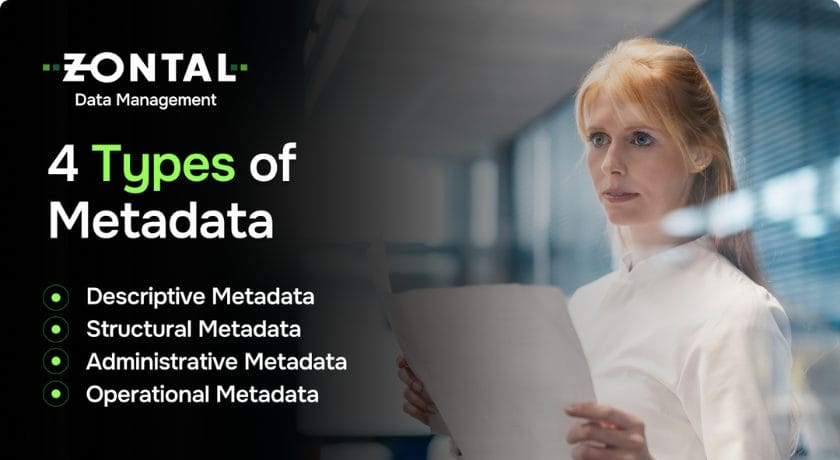
Types of Metadata
To get the most out of your data, it’s important to understand the different types of metadata and how they work.
1. Descriptive Metadata
This category captures the basic attributes needed to identify and retrieve data. It includes titles, creator names, timestamps, and keywords. Descriptive metadata is essential for data discovery and cataloging.
2. Structural Metadata
Structural metadata defines how different elements within a dataset are organized and interrelated. It serves as a framework, describing:
- Hierarchies
- Links
- Relationships, such as the structure of relational databases or the directory paths in a data repository
This type ensures data can be interpreted and navigated correctly across systems.
3. Administrative Metadata
This type supports governance and compliance by capturing technical and custodial information. It includes details such as:
- File formats
- User permissions
- Data stewardship roles
- Creation or modification dates
Administrative metadata plays a central role in ensuring data security, auditability, and regulatory alignment.
4. Operational Metadata
Operational metadata records how data is processed and flows through systems. It includes:
- Data lineage
- Processing logs
- Transformation history
- Quality metrics
This information is critical for understanding provenance, ensuring reproducibility, and optimizing data pipelines for data analytics and reporting.
How Do FAIR Data Principles Influence Metadata Management?
The FAIR principles (Findable, Accessible, Interoperable, and Reusable) define the standards for organizing scientific data in a way that maximizes its long-term value.
At the heart of all four principles is metadata. Without it, you can’t discover, share, or reuse data.
- Findable: Structured, well-defined metadata makes data easy to locate. It includes searchable tags, persistent identifiers, and clear descriptions, enabling researchers to quickly discover relevant datasets without manual digging.
- Accessible: Metadata also spells out how to get to the data: who can access it, where it’s stored, and what protocols are required. Even if the data is restricted, the metadata still tells you it exists and how to request it.
- Interoperable: For data to move across systems and tools, the metadata needs to speak a common language. That’s where standards, controlled vocabularies, and ontologies come in, ensuring everything connects and makes sense.
- Reusable: Metadata tells the backstory; how the data was generated, who owns it, and how it can be used. This context enables researchers to repurpose data for new studies, models, or applications without starting from scratch.
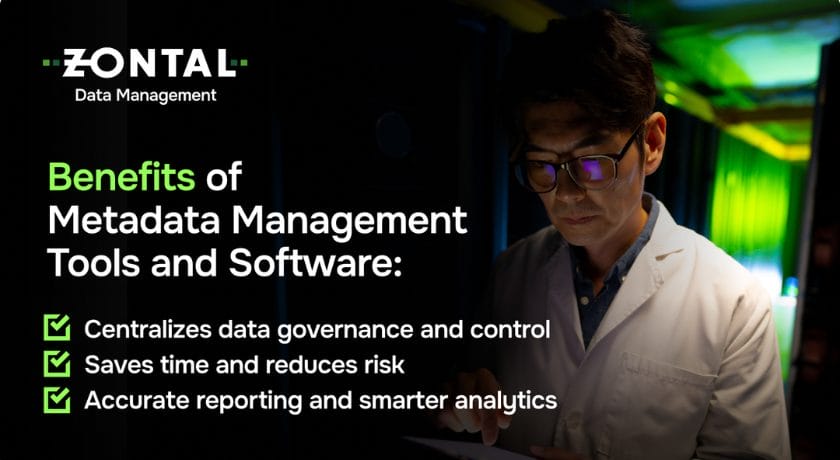
3 Benefits of Metadata Management Tools and Software
If you want to get more out of your data, start by managing the details behind it. Here’s how metadata management software delivers measurable impact across your organization.
1. Centralized Data Governance and Control
A well-structured metadata management system brings together data from ELNs, LIMS, and lab instruments into a centralized, governed environment.
By applying consistent naming, controlled vocabularies, and ownership rules, it supports GxP compliance, audit readiness, and seamless collaboration across teams.
This approach isn’t just theoretical, and industry research backs it up. A 2024 study of over 300 life science tools highlights that standardized metadata is essential for maintaining traceability and strong data governance.
2. Automation That Saves Time and Reduces Risk
With manual tagging, tracking, and documentation off your plate, automation streamlines how metadata is collected, maintained, and updated.
The result is faster workflows, fewer errors, and more time for teams to focus on strategic initiatives.
3. Stronger Reporting and Smarter Analytics
Well-managed metadata makes it easier to find the right data by indexing key details like:
- Compound IDs
- Assay types
- Protocol versions
By using standardized definitions and capturing data lineage from raw output to final reports, metadata brings clarity to complex data environments.
This transparency enables faster troubleshooting, more accurate reporting, and better decision-making, driving innovation and reducing risk across R&D and manufacturing.
ZONTAL’s Role in Streamlined Metadata Management
ZONTAL makes it easier to organize, track, and share your scientific data, so your teams can stay compliant, work more smoothly together, and get more value from the data you already have.
1. Captures Metadata Across the Lab
ZONTAL connects to ELNs, LIMS, instruments, and other lab systems to automatically capture metadata, like sample IDs, instrument settings, and timestamps, right at the source.
This ensures the data is preserved from day one.
2. Standardizes and Harmonizes Metadata
By applying consistent vocabularies and data models, ZONTAL helps standardize metadata across departments and systems.
This eliminates confusion, supports interoperability, and makes your data FAIR compliant.
3. Tracks Lineage and Provenance
ZONTAL gives you clear visibility into the who, what, when, and how of every data interaction, ensuring a complete, trustworthy audit trail for each dataset.
Whether you’re preparing for an inspection or investigating an issue, our platform lets you trace the full history of your data with ease.
4. Makes Data Easier to Find and Use
With centralized, searchable metadata, ZONTAL lets scientists instantly locate data by compound, protocol, analyst, or any relevant tag.
No more digging through data silos or guessing which version is correct.
5. Prepares Data for AI and Advanced Analytics
Clean, well-structured metadata is the foundation for any AI or machine learning initiative.
ZONTAL gives your team the metadata structure needed to train models, analyze results, and scale insights across R&D and manufacturing.
Centralize, standardize, and govern your data.
Metadata Management in Life Sciences: FAQs
What is the main purpose of metadata management?
Metadata management organizes and defines your data, making it clear what the data represents, where it originated, how it’s been handled, and who has permission to use it.
The result? Data integrity, faster discovery, better collaboration, and easier compliance.
How does metadata management support FAIR Data principles?
Metadata is what makes FAIR possible. It supports each principle by:
- Findable: Making data easy to locate with unique identifiers and searchable tags
- Accessible: Defining how and where data can be retrieved, including access conditions
- Interoperable: Using shared standards and vocabularies so systems can exchange and understand data
- Reusable: Capturing context, ownership, and usage rights so data can be confidently reused in new studies or systems
What are examples of metadata in life sciences?
In life sciences, metadata can include things like:
- Sample IDs and assay types
- Instrument settings and method versions
- Experiment timestamps and operator names
- Protocol references and reagent lot numbers
- File types, data lineage, and access permissions
All of this context helps teams trace results, validate findings, and reuse data across studies, departments, or regulatory filings.
Curious about metadata management?


